Building Systems, Not Just Services: What Small Businesses Can Learn from Operational Discipline
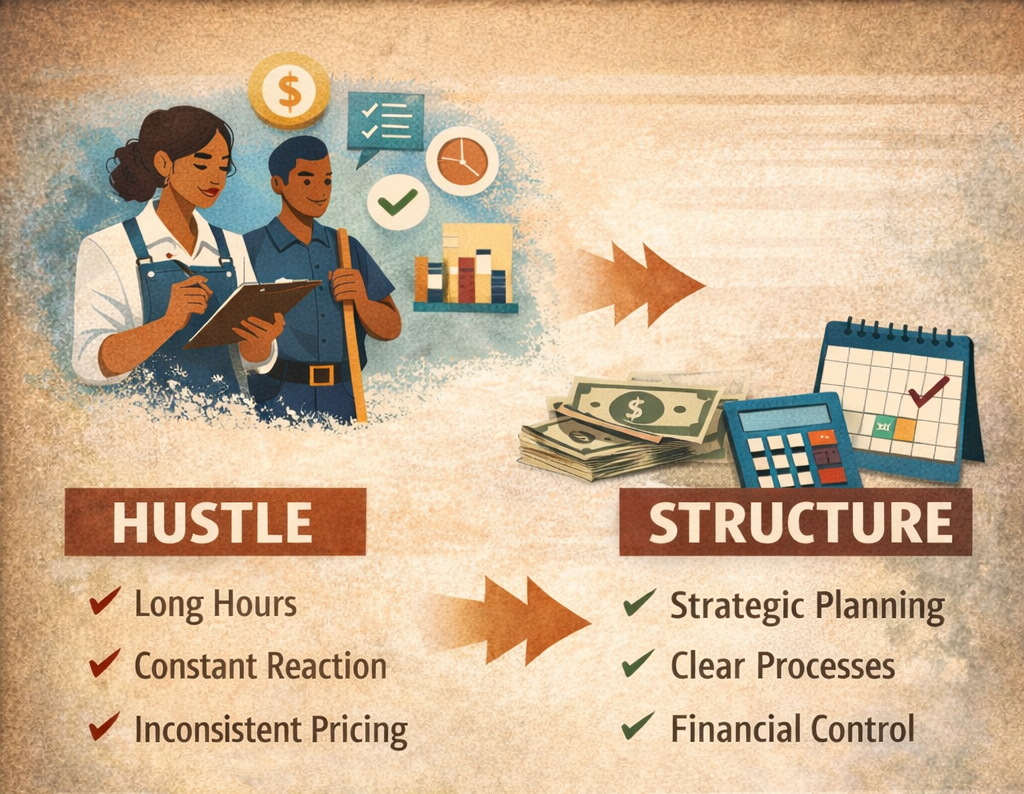
Small businesses grow when they replace constant reaction with clear systems—strategic planning, strong negotiations, and disciplined financial management. Sustainable growth isn’t built on effort alone; it’s built on structure.
Across many communities, small businesses are often built on determination, skill, and long hours. What they frequently lack is not talent or work ethic—it is structured operational systems. When businesses operate without clear systems for pricing, negotiations, scheduling, and financial management, growth becomes difficult and sustainability becomes uncertain.
At Nour Navi, we believe that economic empowerment is not simply about launching businesses. It is about helping founders build durable operational infrastructure that allows those businesses to grow, generate wealth, and remain stable through economic uncertainty.
Entrepreneurship without structure often turns into constant reaction: responding to customer calls, adjusting prices on the fly, and trying to keep up with expenses without a clear financial picture. Over time, this reactive approach can exhaust founders and limit the long-term potential of their companies.
What separates businesses that struggle from those that thrive is often a simple but powerful difference: operational discipline.
The Importance of Structured Business Cycles
Successful businesses rarely operate in a state of constant improvisation. Instead, they follow predictable operating cycles that include planning, execution, evaluation, and improvement.
A structured monthly cycle forces founders to step back from daily operations and examine key questions:
What revenue goals should be reached this month?
What new partnerships or opportunities should be pursued?
How effective are current pricing models?
Are operational costs under control?
By revisiting these questions regularly, businesses can maintain strategic direction rather than drifting from one opportunity to the next.
This kind of discipline is especially important for service-based businesses, where income depends on a consistent flow of clients and well-managed operations.
Negotiation as a Business Skill
Negotiation is often misunderstood as a high-pressure tactic used only in large corporate deals. In reality, negotiation is part of everyday entrepreneurship.
Every estimate, contract discussion, or partnership conversation involves negotiation. Founders who approach these discussions without preparation risk underpricing their services or agreeing to terms that weaken their business.
A structured negotiation process typically involves several stages:
Preparation – understanding the job or opportunity before discussing price.
Information gathering – learning the needs and expectations of the other party.
Opening discussion – clearly presenting the value of the service being offered.
Bargaining – adjusting scope or options while protecting the core value of the work.
Agreement – confirming price, timeline, and expectations.
Relationship management – maintaining connections for future opportunities.
When negotiations follow a disciplined process, they are far more likely to produce fair agreements and long-term partnerships.
Financial Awareness: The Foundation of Sustainability
Another major challenge for small businesses is financial visibility. Many entrepreneurs track revenue but do not consistently track profit margins or cash flow.
These three indicators determine the real health of a business:
Revenue – the total income generated from services or products.
Expenses – operational costs such as materials, labor, transportation, and technology.
Cash flow – the actual money available to operate between payments and expenses.
A business may generate significant revenue but still struggle if expenses are not controlled or payments are delayed. Clear financial tracking allows founders to make informed decisions about pricing, hiring, and expansion.
Moving from Hustle to Structure
Entrepreneurship often begins with hustle: working long hours, taking every opportunity, and building relationships. While that energy is important, it cannot remain the primary operating model forever.
To grow, businesses must transition from hustle to systems.
Systems create repeatable processes for:
client acquisition
service pricing
negotiation and contract management
operational scheduling
financial oversight
Once these systems are in place, founders gain something that is far more valuable than constant activity: control over their business trajectory.
Nour Navi’s Commitment to Economic Infrastructure
At its core, Nour Navi exists to strengthen the economic infrastructure that supports communities. That work includes more than training or inspiration. It requires building the frameworks that allow entrepreneurs to operate confidently and sustainably.
When founders have access to clear operational systems, they are better equipped to:
grow their businesses responsibly
create stable employment opportunities
build long-term financial resilience
Economic empowerment is not achieved through isolated success stories. It is built through structured systems that allow many businesses to thrive at once.
Operational discipline may not be glamorous, but it is one of the most powerful tools entrepreneurs can adopt. When businesses combine vision with structure, they move beyond survival and begin building lasting impact.
